
Lincoln Parish Court Records After Arrest
A Lincoln Parish arrest normally starts at the custody stage. The person is booked into Lincoln Parish Detention Center, and the roster may show the name, booking date, arresting agency, physical descriptors, and charge text. That is not the final court file. The court file opens through the Lincoln Parish Clerk of Court after a citation, indictment, arraignment, minute entry, or other criminal filing is entered in the Third Judicial District Court record.
The Third Judicial District Attorney serves Lincoln and Union Parishes and decides what charges to pursue after police or deputies make an arrest. Roster charges may be amended, reduced, refused, or replaced by formal counts. For custody and booking details, use the Lincoln Parish jail inmate records page. For booking photos, use Lincoln Parish jail roster mugshots. The court record is where filed charges, court dates, minutes, motions, disposition, and sentence are verified.
The Lincoln Parish Clerk's Criminal Department says it maintains criminal records for citations, indictments, arraignments, and dispositions. The minute clerk keeps minutes for each docketed case, and those minutes are available for public view after they are typed. That makes the clerk file the main source for court records after a jail arrest, while the sheriff roster remains the current-custody source.
Find Lincoln Parish Court Records
Court records after a Lincoln Parish arrest can be checked through the clerk's office in person or by mail, through Clerk Connect, and through the statewide eClerks/eVaultLA portal. Clerk Connect lists Lincoln Parish Clerk Online Inquiry and offers paid access to criminal, civil, property, and land record modules depending on the office service. Public users who do not have a portal account can still contact the Criminal Department.
- Start with the defendant's full name from the LPDC roster, a citation, or a court notice.
- Check Lincoln Parish in Clerk Connect or contact the Clerk's Criminal Department for the case record.
- Open the criminal case and compare filed charges against the original booking charge text.
- Review minutes, arraignment entries, motions, warrants, disposition, and sentencing notes.
- For a copy request, ask the clerk about page fees, certification, and whether the record is complete.
The Lincoln Parish Clerk criminal page lists criminal background searches for $20. The Clerk Connect fee page lists criminal day-pass access at $25, monthly access at $100, yearly access at $1080, and copies at $1 per page. Those fees apply to clerk access, not sheriff custody confirmation.
Lincoln Parish Case Lookup Fields
The research did not locate a public no-login screenshot of every Clerk Connect search field, but the access model is clear. The paid portal requires an account or pass, the parish or office must be selected, and the criminal module is the relevant record type for charges after an arrest. That differs from the LPDC roster, which is free and current-custody focused.
| Field or Step | Type | Required | Notes |
|---|---|---|---|
| Account login | Web account | Yes for paid portal | Clerk Connect uses subscription or day-pass access for Lincoln Parish inquiry. |
| Parish or office | Portal selection | Yes | Select Lincoln Parish Clerk Online Inquiry. |
| Record type | Module | Depends on access | Use criminal records for filed charges, minutes, and dispositions. |
| Name or case search | Text | Unspecified | Portal field labels were not visible without access during research. |
| Printing and copies | Portal action | No | The clerk lists copies at $1 per page. |
The Lincoln Parish Clerk criminal department page is the source for criminal filing duties and background-search pricing.
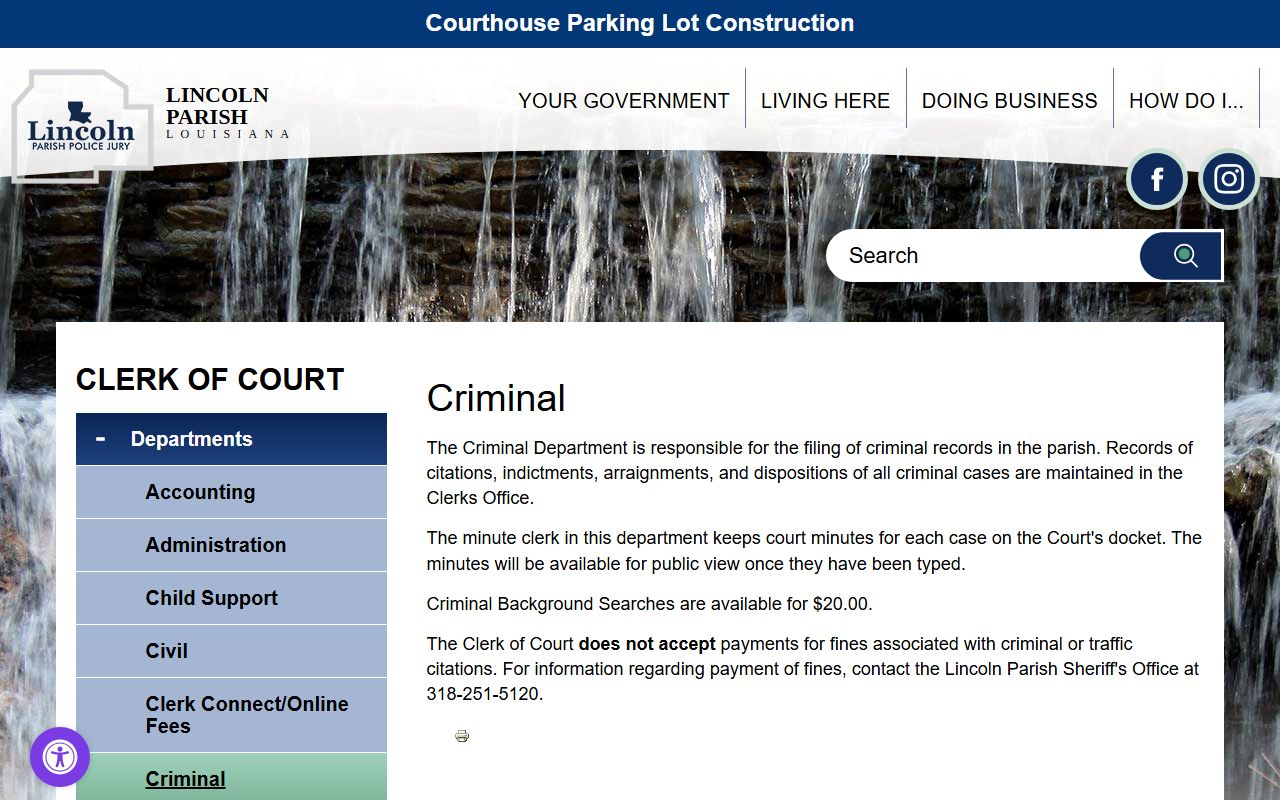
The screenshot shows the local clerk source readers need after a jail arrest moves into filed court charges.
Charges After Lincoln Parish Arrest
An arrest charge is the intake description entered when the person is booked. A filed court charge is different. After review, the district attorney may file a bill of information, seek an indictment, decline prosecution, reduce the count, or add a charge not shown in the original roster entry. The court record after a jail arrest is the best source for that formal filing history.
| Document | Who Uses It | What It Means |
|---|---|---|
| Complaint or citation | Officer, agency, or prosecutor | Starts or supports a charge based on the arrest facts or citation. |
| Bill of information | District attorney | Common Louisiana prosecutor filing that states the formal charge. |
| Indictment | Grand jury | Formal charging document often used for more serious felony matters. |
The Third Judicial District Attorney is the prosecuting office for Lincoln Parish. John Belton is listed as district attorney, and the office has felony, misdemeanor, juvenile, child-support, victim-assistance, and service contacts. That office prosecutes; the clerk maintains the filed case record.
Lincoln Parish Charge Status
Court records after a jail arrest should be read for status, not just for the first charge line. A pending charge has not reached final disposition. An amended charge may replace a booking charge. A dismissal or nolle prosequi means the prosecutor did not continue that count. A sentence entry follows a plea or verdict, while an expungement entry may limit public access later.
| Status | What It Means in the Court Record |
|---|---|
| Pending | The filed charge is still open and has not reached a final disposition. |
| Amended or reduced | The filed count changed from the original charge or a later count replaced it. |
| Dismissed | The court record shows the count was ended without a conviction on that count. |
| Nolle prosequi | The prosecutor declined to continue the charge, often shortened to nolle pros. |
| Disposition | The court record records the outcome, such as plea, verdict, dismissal, or sentence. |
These terms matter because the LPDC roster can still show the booking charge that started the case. A reader checking court records after arrest should verify the case file before treating a roster charge as the final accusation or outcome.
Bond After Lincoln Parish Arrest
Lincoln Parish-specific bond posting instructions were not located on the sheriff detention pages. The local roster feed also does not display bond amounts in the sampled record fields. For bond or release questions, call Lincoln Parish Detention Center at (318) 255-4440 or the sheriff line at (318) 251-5111, then confirm the exact bond type, posting place, accepted payment method, and any holds the same day.
| Release Term | Plain Meaning |
|---|---|
| Cash bond | The court requires payment of the full cash amount before release. |
| Surety bond | A licensed bondsman backs the bond under Louisiana bonding rules. |
| Personal recognizance | The court allows release on a promise to appear without full cash deposit. |
| No-bond hold | The person cannot clear custody through an ordinary bond payment. |
| Detainer or hold | Another agency or court claim may block release even after one bond is posted. |
The LPDC roster showed local examples of holds, including probation or parole holds, bench warrant failures to appear, fugitive other jurisdiction entries, drug court matters, and bondsman-off-bond entries. Those entries explain why a person may remain in custody even when one charge appears bondable.
Warrants and Court Records
No official Lincoln Parish active warrant search page was located on the sheriff website during research. A warrant can still appear in court records after a jail arrest because the booking charge may list a bench warrant, fugitive hold, probation or parole hold, contempt entry, or bondsman-off-bond issue. A bench warrant usually means a court ordered arrest after missed court or noncompliance.
For warrant questions, do not rely on a website if an appearance or arrest risk is current. Call the sheriff at (318) 251-5111, call LPDC for custody status, or check the specific court case through the Clerk of Court. Public records requests may help with older booking or warrant-related reports when those records are not confidential or tied to an active investigation.
Note: VINELink can monitor custody after booking, but it is not a warrant-clearing or court-payment system.
Charges vs Convictions
A court record after a jail arrest may show a charge long before it shows a conviction. A charge is an accusation filed in court. A conviction follows a guilty plea, verdict, or qualifying judgment. Dismissed, refused, or amended charges should not be read as convictions.
| Question | Charge | Conviction |
|---|---|---|
| Stage | Filed accusation after arrest review | Final guilty outcome by plea or verdict |
| Where verified | Clerk criminal file and case minutes | Disposition and sentencing entries |
| Can it change? | Yes, it may be amended, reduced, or dismissed | Later relief may require appeal, post-conviction action, pardon, or expungement where allowed |
Sealed and Expunged Records
Louisiana expungement rules are not the same as a roster update. The research points to the Louisiana Code of Criminal Procedure expungement articles for arrests without conviction, misdemeanor convictions, and felony convictions. An expungement may restrict public access to a qualifying record, but it does not mean every agency record vanishes from every internal system.
| Term | Meaning | Lincoln Parish Source to Check |
|---|---|---|
| Restricted or sealed | Public access is limited by court order or law. | Clerk criminal file and court order. |
| Expunged | Public access to an eligible arrest or case record may be restricted. | Expungement articles and the court case record. |
| Dismissed | A count ended without conviction, but the file may still show the filing history. | Disposition minutes and clerk record. |
For booking photos on remove-for-pay sites, Louisiana Code of Criminal Procedure art. 234 has a separate removal rule. That law is about booking photographs and commercial removal fees, not general court-file expungement.
Louisiana Records Law
La. R.S. 44:31 gives adult persons the right to inspect, copy, or reproduce public records unless an exception applies. La. R.S. 44:32 describes custodian duties, reasonable copy fees, and the five-business-day written determination rule when public-record status is questioned. Those laws support requests for sheriff records when online jail or court tools do not answer the question.
Some records remain limited. Juvenile records, sealed or expunged matters, active investigative material, and records blocked by a specific exception may not be released through a routine request. Court records after arrest should be verified through the clerk, while current jail custody should be verified through the sheriff or LPDC.
Important: Court and custody data can be incomplete or delayed; verify legal status with the originating office before acting.
Search Public Records
Sponsored Results